Parliament of Owls began as a big week of birding for artists to observe birds in the field with bird nerd experts during spring migration in Ottawa. We visited the Ornithology collection at the Museum of Nature, we learned to identify birds by song with the Ottawa Bird Count, we helped rescue birds injured in window collisions with Safe Wings Ottawa. When the program moved online in 2020 we expanded our research to include ornithologists at many international Universities including Cornell and Cambridge. We have had the pleasure of studying insects with the following artists Click on images to see more about each artist. |
|
Alexis Williams, Ottawa, Ontario Alexis is an everyday wildlife photographer seldom seen without her long lens slung over her shoulder. The camera acts as a touch stone to maintain focus and ensures every effort to observe ambient wildlife or as a stand in for a foraging basket. She has been photographing birds obsessively since 2020, previously, her wild mushroom photography obsession spanned over a decade. Making daily lists of bird sightings keeps her happy and connected to seasonal nuances. Seeking out new birds to photograph and draw takes her to wild places around the world. She is deeply interested in bird behaviour and communication, especially inter-species interactions. She is currently in Mexico working on bringing her life list up from 500 to 600 species. |
Many of my pieces move from place to place, sometimes through space and sometimes through ownership. Printmaking provides the conceptual spine that supports my interdisciplinary practice. My art pieces are almost always interactive, asking the viewer to physically place themselves in this portrait of connectivity. Nowadays we do not rely on movable type to get us our daily news. It seems that we no longer rely on the accuracy of the artist’s hand to illustrate scientific information. Printmaking mobilized the first information revolution. We are experiencing another one, and this one did not appear out of thin air. I am looking to expose the seemingly invisible lines that connect our day to day experiences with a larger mechanism. It appears to me that Botanists are sometimes doing the same thing. The parking ticket you got last week, the souvenir from your last vacation- these artifacts all have a complex history. They quietly shape an experience that you are actively participating in. |
My artistic practice unfolds over more than two decades of practice. My work has evolved through multiple mediums, from individual paintings on canvas, to series and, more recently to objects and dioramas.. I intertwine different thematic thoughts, allowing associations to accumulate, overlap, and transform. My work exists within a portal between memory, farewell, and transformation, where art becomes a threshold and a language for what remains. At its core, my work explores death and transformation. I have collected hundreds of overlooked, abandoned, and discarded objects, focusing on the silent narratives embedded within them. As I form them into art, these remnants are honored as witnesses and carriers of mortality, nostalgia, and persistence. |
 Krista Dalby, Picton, ON Nature has been a lifelong source of artistic inspiration for me. More than 20 years ago I cut my teeth as an artist working for a theatre company in an urban park, and my life has never been the same. I have created a lot of work intended to be presented outdoors; including plays, art installations, processions, dance events, giant puppets, workshops and concerts, all en plein air. In 2010 I moved to a rural community, and wilderness is a constant presence and source of wonder in my life (just this morning I pulled over to the side of the road to watch otters playing on a frozen creek). |
Drawing on her experience with the world of nature, Maryse Goudreau creates universes that accompany us as we grapple with unprecedented environmental issues. Her work sometimes takes the form of books, playwriting or cinematographic narratives, and more often in visual art exhibitions that emerge from conversations, shared experiences with various scientific actors or artistic complicities. Her work is a hybrid of photography, video essays, sculpture, immersive devices, action art and social art, with several participatory projects, including Manifestation pour la mémoire des quais and Festival du tank d'Escuminac - first and last editions.
|
My artwork looks at history, memory and violence through the aperture of the archive: assembled and accidental. I create films, video installation, and 2D, photo-based, mixed-media works. Born in Santiago, Chile in 1967, I came to Canada as a refugee following the 1973 military coup that ousted elected president Salvador Allende. This event – the experience of exile and its reckoning – is integral to my artistic practice. |
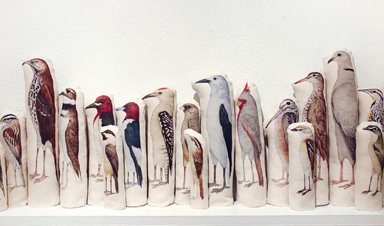
 Adele Medina O'Dowd, Chevy Chase, MD My ceramics reflect a personal exploration of particles, molecules, organisms, and natural forces, how they interact and emerge in liminal space, and what physics, chemistry, ecology and biology reveals to us about the universe. I am astonished that even while we are immersed within it, the way the universe functions is nearly invisible to our senses and perception. Discussing this with others is mindblowing and joyful. We grasp it better with observation and contemplation—something I do, perhaps excessively. I’d like to live in a universe where scientific conversation is normal and fluent. We can do that. |
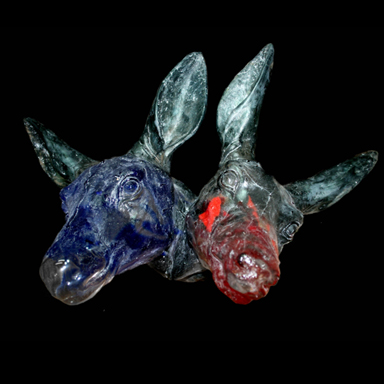
Deana Bada Maloney is a multi-medium versed artist and past scientific illustrator who uses ceramic sculpture as the main vehicle to explore the magic and mystery of the natural world. Her work is a deep study of living forms, celebrating the inherent structure of the subject while emphasizing its transcendental presence. |
My work is a call to action for people to notice their animal neighbors and take the time to understand or appreciate them. The animals I depict are often overlooked, misidentified, or misunderstood. By highlighting “ordinary,” urban animals in my work, I remind the viewer that humans share a space with wildlife. I believe the first step to caring about something is knowing it exists. It is generally hard for people to think in abstract concepts but if you can point out an animal, call it by its name, and pass on information about it, then maybe steps will be taken to understand it better. I personally take simple pleasure in sharing moments with the animals I encounter every day, but it is an impossible task to try to get everyone to love every animal. However, I can hope to help people recognize an animal’s place in our shared ecosystem. |
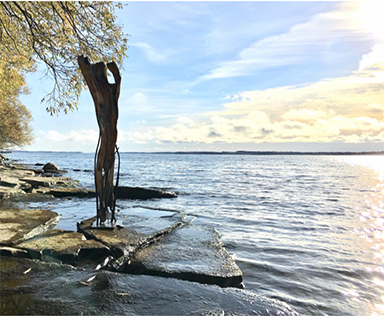
For decades, my life on an island near Kingston, Ontario, provided inspiration and materials for art-making. A walk on a shoreline was a gathering opportunity. Surrounded by fields, water, and sky, my compulsion to carve, paint, and draw took hold. |
Carly Carly is a British interdisciplinary information designer currently based in Michigan whose developing practice explores birds through mixed media, photography, and data visualization and storytelling. Her work is informed by many years of bird rescue, care, and conservation involvement, alongside a background in research, evaluation, and data-focused work. She is deeply committed to creating work that deepens public awareness, |
 2022 online |
Tiffany Deater, Fulton, NY We live in a culture that thrives on drama and conflict; a barrier between the imagined and the real. This desire for social tension extends beyond the human, and we impose our ideologies onto the animals and environment around us. |
Mary Wilhelm, Tempe, Arizona My work is a modern Aesop’s fables, with stories and mythologies that encourage people to not only consider the complex relationships of animals, but also our relationships with each other. As an artist, I often delve into the deeply weird world of online forum discussions, current political events, human psychology, and various spiritual philosophies that influence the narratives of my work. I play the role of critical observer, contemplator, and commentator, my work not only being a way of digesting the world around me, but a way of sharing these thoughts with others. Animals are the vehicle through which to speak about these observations. Each animal is specifically chosen due to certain biological characteristics or behaviors that I feel lend themselves to the narrative.. People often project their own ideals and psychology onto various animals as a way to understand themselves. Animals become a projection of human behavior; often flattened into a two dimensional avatar for our own projection. |
My name's Rose and I'm a concept artist and illustrator specialising in Creature Design, Speculative Biology and SciArt. I'm also the creator and Course Leader of BA (Hons) Comic & Concept Art and MA Creature Design at Leeds Arts University. I live by a river with my husband and polydactyl cat. I enquire into worldbuilding and believability in creature design—exploring creature design methods, science/art collaboration, drawing as inquiry, human-animal relationships, and communication of these themes to wider audiences through interactive platforms. These themes are important and original because they are cross-disciplinary and aim to instil curiosity and concern for biodiversity. My work has been featured in Speculative Biology zines, eco-educational board games, and I have exhibited alongside Creature Designers Terryl Whitlatch, Brynn Metheney, Kate Pfeilschiefter, and Iris Compiet as part of Creature Design: ex femina; an exhibition celebrating women in creature design and eco-feminist perspectives. I have a BA (Hons) Visual Communication (Illustration) with First Class Honours from |
My inspirations and artistic process as dance artist are deeply coloured by my naturalist parents: raising butterflies in our bathroom, rehabilitating hawks and owls in our garage, collecting samples of rare wildflower species. I always have an eye on the relationship between humankind and nature. Where does animal instinct meet the poetry of art and science? What can we discover by looking at it through this prism? The birth of my son has motivated me to find deeper roots for my art: how can it move through my community in a way that is visible, positive, engaging and inspiring for anyone? This is manifesting now in ideas clustered around physics, ecology and cosmology. How poetic naturalism (the natural laws and philosophies or stories we tell about them) translates into a visceral moving beast, how dance performance can cause all participants to resist cynicism, to consider and care more. I am so inspired by the gorgeousness of human accomplishments. We are capable of such cleverness and ingenuity, surely we can solve and heal where we’ve damaged and neglected. I want to be part of that process, connecting ideas, sensations, filtering it through dynamic, imaginative bodies to offer some thought-provoking spark. I don’t know if I’m doing that, yet, but I’m trying. After 20 years of making and dancing, there is so much more to learn.
|
Jane Mutiny, London UK I grew up in Dorset, UK, and graduated from Falmouth College of Arts in 2007, after which I moved to east London. There, I became immersed in the street art scene, creating murals and artworks highlighting environmental, biodiversity and extinction issues. It was through these actions that I gained the moniker Mutiny. I work across a variety of scales and mediums from pencil drawings, ink and oil paintings, murals and street art, and more recently film. My work is inspired by the wild, human nature, poetry and mythology. I am also greatly interested in science and natural history, particularly birds, which I use to guide my creative work. Alongside my art practise, I sometimes give public talks and workshops on bird identification. With a history enmeshed in the visual dialogue associated with issues around endangered species, and a deep knowledge of the natural world, my work is refocusing on the mythical, poetic, social and political resonances that particular species have within
|
Andrea Charise, Toronto, Canada My ceramic forms are generous and substantial, deliberately working with curves, size, and texture to fully realize clay’s intrinsic abundance. My functional work often involves wheelthrown, iron-rich, cone 6 stoneware decorated with rustic, expressive lines and non-toxic, food safe glazes. My one-of-a-kind sculptural works explore more abstract, larger-scale, often coil-built forms, ornamented with innovative, experimental glaze formulas developed in conversation with each unique ceramic object. Both functional and sculptural works reflect my interest in emphatically textured, even weathered, surfaces: an aesthetic translation of my professional background in geriatrics, and a personal meditation on the inevitability of aging’s marks on bodies--flesh and clay alike. |
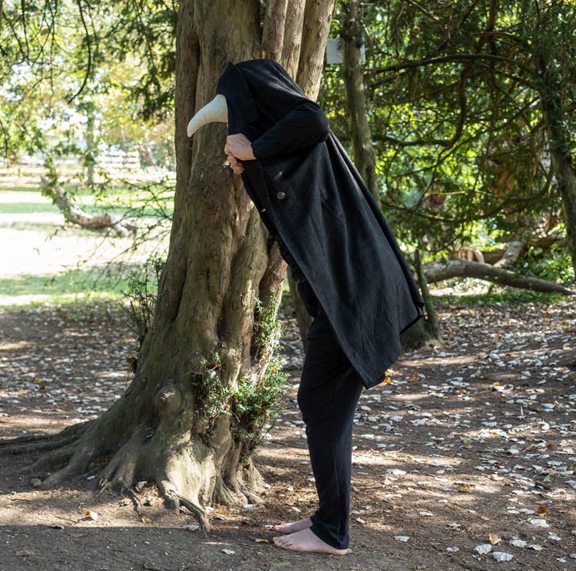
Annie Rapstoff, Oxfordshire, UK I am an interdisciplinary artist, interested in the human condition and relationships with other beings in the widest sense of the word. I often work in response to the life of the land and am currently exploring the interrelationship and possibilities for dialogue between humans, birds and trees. At present my concerns include possibilities of transformation and embodiment exploring the hidden depths of what is heard, felt and experienced through the often unnoticed. I ask questions regarding relationships between nature and humans influenced by animism, somatic practice, deep listening and phenomenology. My practice includes performance, text, book art and stitch. Work can be collaborative, process-based or ephemeral, taking the form of instructions, events, performance for the camera and in situ, gestures, interventions, video and writing/language. During lockdown in 2019, a discussion around mask wearing took traction. I became interested in the costume worn by the plague doctors. At the same time I was aware of the growing sound of bird song, accentuated by the reduction in traffic pollution and noise. I began making masks, extending their shape into elongated beaks, which I wore to experience new perspectives and interactions between human and bird bodies. |
Sahar Te, Toronto, Canada I am a Toronto-based artist and writer. My practice exists at the intersection of text, installation, and performance. With my work, I attempt to challenge common approaches to “original” content and look into how parallel contrasted realities often exist simultaneously. My interventions range from linguistics and semiotics, social dynamics and ethics, to media studies and oral histories. Through each project, I engage in sociological, geopolitical, and techno-political discourses to understand hegemony within different power structures. |
Yula Kim, London, United Kingdom My aim is to research the correspondence between the history of human use of birds for their cultural, political, and artistic developments and how these issues have raised the question of human idea of morality and emerge in this world. Also, I am interested in learning biological and ecological order of birds to state their significant roles in our cultural developments in the world, and to conserve natural system in the world. I am particularly interested in birds since birds narrate many parts of our histories of art and scientific discoveries. Their fascinated feathers always have been a subject of fashion to represent the elegance in many cultures across the world, and the numerous zoological and science typical inventions are also influenced by birds and their biological system. Says to be that John James Audubon’s realistic illustrations of American birds in his book Bird of America have provoked numerous scientists who were interested in discover new scientific orders including Darwin’s Evolution Theory. On the other hand, Rachel Carson’s Silent Spring refers the environmental problems through numerous birds examples to state the importance of animals and the natural ecological orders in human life. I have lived in 4 continents and 4 countries (South Korea,
|
 2021 online |
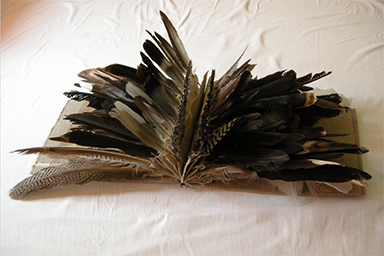
Ashlee Mays, Pigeon Forge, TN As a printmaker, most of the pieces I make derive from some kind of book structure. The structure of a book is simple and its function is intuitive. While books are generally static objects, they are built to be in motion. The spine of a book demonstrates just the right amount of flexibility to allow access. The book form is a vehicle for information, information that was important enough to mechanize and disseminate. Printmaking for me has always been about a mechanism. |
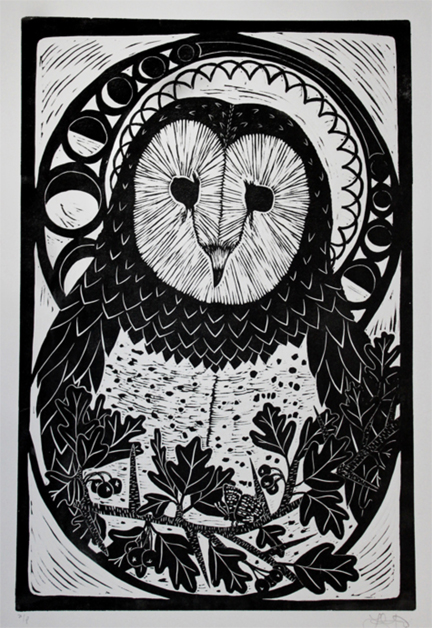
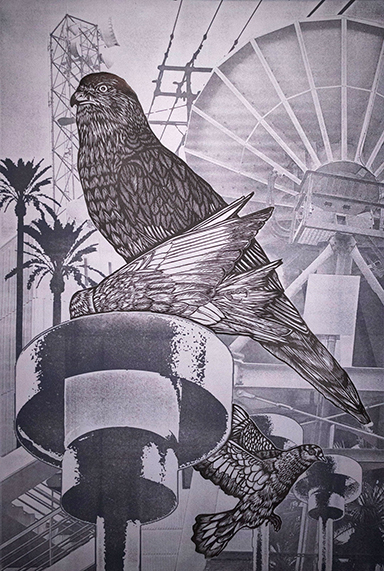
I work mainly in printmaking and drawing. I’ve been an avid animal lover my entire life. I often depict critters I’ve become enamored with as a way to learn more about them. I like to research the life cycle and habitats of the animals I depict. I enjoy finding out weird quirks different species have and fun facts about them. My hope is that I can share the beauty I see in the natural world, even if the subject isn’t one people would normally consider attractive or worthy. Gastropods continue to be a source of wonder and inspiration for me. The more time I’ve spent in nature in recent years has rekindled a childhood love for birds. I have been learning more about identifying them and they have made their way into some prints. I love bright colors and how they can be used to evoke happy emotions. That being said, this past year I have attempted to make more single color prints as a challenge to myself to not rely so heavily on color. I mainly create linocuts, except the times I have access to lithography |
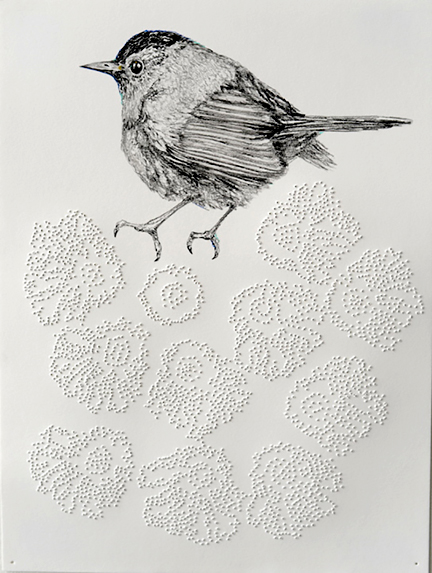
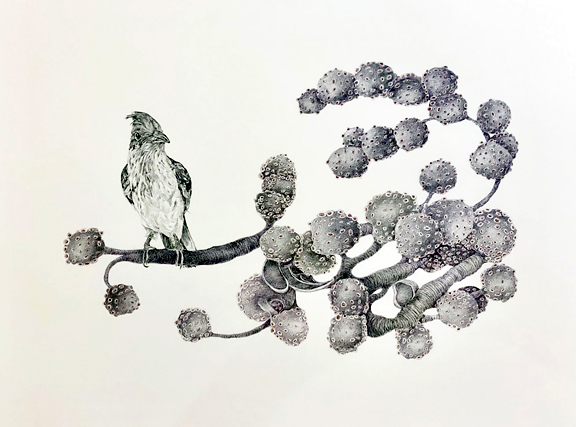 Nancy Hart, Odessa, TX The influences for the current series of bird drawings and collages include my school field trips to the Museum of Natural History in NYC, Audubon bird prints my parents had in our family house, and visits to national history museums in Italy and France. I have also been looking at scientific illustrations from the past, such as those by Robert Hooke. Another influence is from the Arna artist residency program I attended at a bird sanctuary in Sweden. The works are in black and white to reinforce the sense of the past and to give the impression of being drawings from science books. |
I have lived in Cameroun, France, Lebanon and Quebec. Travel and migration have been a large part of my life and this has had a strong impact on my artistic practice. Like documented journeys, my visual art installations and videos pieces tend to be very explorative, meditative and my approach to context and research is deeply influenced by the people and places around me. I am fascinated by traces, those that I discover by chance and collect in my daily life (images and sounds recorded while I am walking) as well as those that I reconstruct/re-enact in my studio (objects, paintings, writings) or come back to (personal archive and found footage). My collections of traces are fragments of experiences that I de-contextualize and re-use differently, allowing geographies and narratives to be juxtaposed and multi-layered. This dense combination makes concepts of time and space travel within my work, like the spontaneous, yet organized trajectories of migratory birds, like the strange sight of a never-ending road, or the liberating sound of waves repeatedly crashing on the shore.
|
Stephanie Hill, Wakefield, QC I grew up in Cornwall Ontario Canada, spending summers at our cottage on the Saint Lawrence River surrounded by extended family and miles of life filled wetlands. It’s no coincidence that much of my work focuses on family and relationships, both with others and with the natural world. I graduated from the Ontario College of Art and Design (OCAD) and was privileged to partake in the college’s off-campus program in Florence, Italy. Inspired by Medieval and early Renaissance masters, my work uses symbols and mythologies to reveal a powerful and rich story. Painting is an emotional and intuitive experience for me and I often portray water, trees, flowers, animals, and insects to create a world where dreams, unconscious desires, and the divine come into play. I tend to work with oil on linen, yet also enjoy drawing on paper with watercolours, oil pastel, and pen and ink. I see my art as a deep expression of aliveness and transformation. I hope to bring those who encounter my work on a compelling and delightful journey of self-discovery that reveals the ever-changing dance between the world around us and the one within. I currently live in Wakefield, Quebec on the Gatineau River.
|
My mission in life is to connect people to the outdoors. To foster that connection so that we may protect wild places. It's been the defining purpose in my work as an outdoor leader, teacher, activist, and now, as an artist. While I'm new to art, I am not new to the inspiration, or to the daily pursuit of wild experiences. With respect to photography, I've spent the last year on a serious, daily effort to photograph birds in their natural surroundings. Learning about light, bird behavior, songs, calls, aperture, shutter speed, and my own personal vision has given me a new perspective on the natural world. And now, as my work turns more abstract, I’m focused on capturing the essence of birds and their habitat -- to present something others want to experience. My work is at its best when it contains a mix of the literal, the mysterious, and my wonder, all at the same time. Building this project over the last year has been a life-force for me and my community. Through such a difficult time, we can find connection in the beauty of the wild things in our own backyards. I can't bring the people to wild places, so I bring the wild places to the people. |
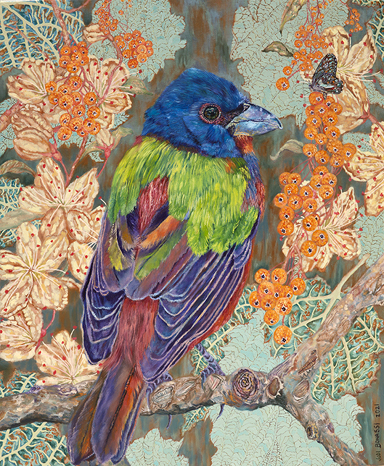
Jodi Bonassi, Canoga Park, CA My fascination with birds came out of an urgent need during the pandemic to feel connected to nature and flight. In the past, I had always studied people in places of communal exchange. Due to the pandemic, I turned to nature to heal myself and others during this uncertain time in our history. The Museum Of Art And History (MOAH) was thrilled in my new path and birds are now a focus of my work. The birds will be on exhibit in February 2022. I want to go further. I have a strong desire to learn about the different bird species, the growing issues of their loss of habitat due to environmental and building and climate change, so I can enhance my creative journey. Birds and nature have brought me a serenity, peace and new inspiration. We must preserve our wildlife and create a safe place for our feathered friends.
|
Alexandra Desipris, Newark, NJ Alexandra Desipris is a painter, sculptor, and researcher of Greek descent based out of Newark, NJ. Her work is about diaspora, displacement, loss, and death. |
2020 online |
Ashlee Mays, Pigeon Forge, TN As a printmaker, most of the pieces I make derive from some kind of book structure. The structure of a book is simple and its function is intuitive. While books are generally static objects, they are built to be in motion. The spine of a book demonstrates just the right amount of flexibility to allow access. The book form is a vehicle for information, information that was important enough to mechanize and disseminate. Printmaking for me has always been about a mechanism. |
Melanie Long, Calgary, AB My artwork answers the questions that I want to ask the world. My practice is an ongoing |
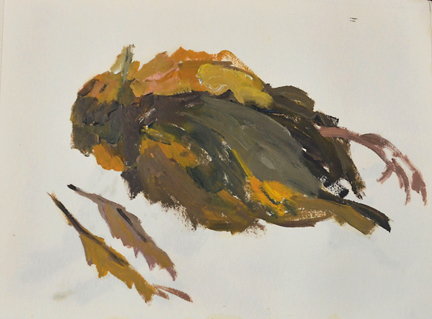
Ellen Little, San Francisco My work is inspired and guided by the natural things I find in my backyard and on my morning walks through urban wild spaces. I am fascinated by how the natural world adapts to the human world. By magnifying that which is small and temporary in nature - flowers, moths, dead birds and other ephemera become poignant reminders of the transience of life. Throughout history flowers have represented fertility and birth while moths have been associated with death and decay. So I combine flowers and moths in my Backyard Series to suggest the interconnectedness and fragility of life where birth, aging and death are intertwined and nothing remains constant. My Urban Bird paintings are inspired by an article in the New York Times about FLAP and the birds that crash into windows. I paint from real bird carcasses that I find or that friends bring me. |
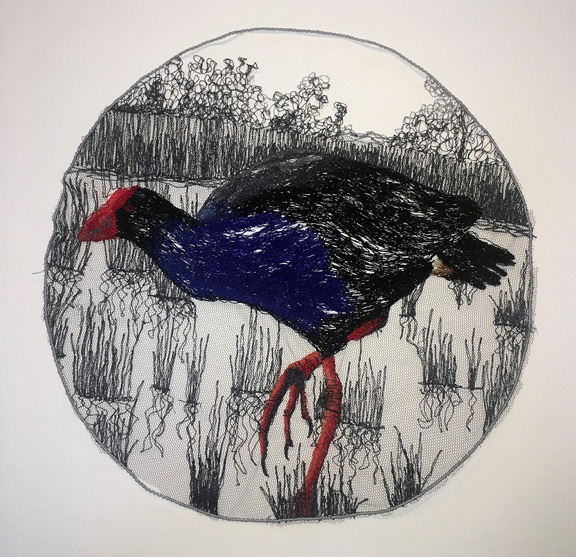
Sharon Peoples, Australia Sharon Peoples has worked as an artist in Canberra, Australia, for over 20 years, exhibiting nationally and internationally as well as taking on commissioned work. Her art practice focuses on textiles, both hand and machine embroidery. Peoples’ work has been collected by national and state institutions. In recent years Sharon has been exploring birds and their relationship to suburban gardens. She has done this through portraits: the inner secret garden, artists’ gardens and gardens of the imagination. Her upcoming exhibition Messenger in the Garden at Timeless Textiles (Australia’s only commercial textile gallery) examines this relationship. Fragility of both the environment and the human condition is reflected in the medium: oscillating between hand and machine embroidery to examine this state. |
Meg Nicks, Canmore, Alberta As a visual artist, the intricate details of nature are captivating. Natureʼs flow and rhythms and the interconnectivity of its patterns and design are subjects for art. The mountain environment is my major focus, an apparently solid, but infinitely changeable environment, where life, tough yet fragile, prospers in a severe world. We must look closely to appreciate all that is here. Flowers, mosses, lichen. The black patterns on aspen trees. Salamanders and seeds. Even the rusting of artifacts left behind. |
Shae Warnick, Columbus, IN Shae is an artist with her roots in nature. If she’s not painting, she’s outside learning the names of things, reading books about birds, or opening drawers in the research collections of natural history museums. Most of Shae’s images are inspired by the ornithological specimens observed in research collections |
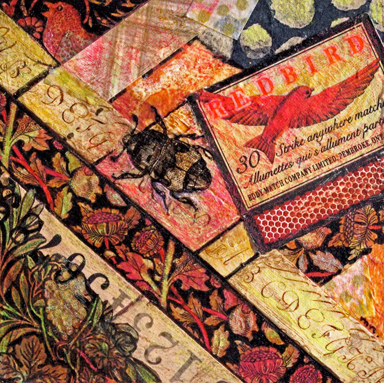
Adelle Pound, Northern Ireland I am a wildlife artist and keen birdwatcher. I work in a number of mediums such as acrylic, watercolour, drawing, collage and cut paper. Fieldwork and drawing from life is central to my practice. This is both a creative endeavour in itself and a way of generating resource material. Studying birds in their natural habitat is a crucial process which drives the ideas that inform the development of new work. In Northern Ireland where we are visited by migratory birds from across the globe. This seasonal coming and going has be part of life and culture here for as long as there have been people to witness it. I am just the latest in a long line of “watchers”. The birds likewise are the latest in generations that go back into the far distant past. In May 2016 I took part, with 11 other artists, in the Copeland Art Project. This took the form of a weekend residency at the Copeland Bird Observatory, followed by a series of developing and evolving exhibitions throughout the summer. This resulted in a short graphic story called “to be Continued”. I am currently researching material for more extended narrative pieces. |
2019 Field Expeditions |
 |
|
|
Julya Hajnoczky, Expedition Leader |
|
 |
Adrian Göllner, Ottawa I need to become a better birder. I am currently amidst the second year of a conceptual art project in which I take note of every bird I see. My art practice involves the transcription of sound, time and motion into visual forms. Recently, this has manifested in attempts to cast explosions in bronze, but this body of work began more gently as experiments in which traces of the past were conjured out of analogue technologies and given form as drawings. In 2017 I began to make lists of all the birds I saw in the day. Conceiving of my avian neighbours as a collective canary-in-the-coalmine for the environment, I thought I might begin to be able to discern patterns that portend something of our shared future. Making visual the ambient presence of birds within our midst certainly accords with nature of my practice, but the resulting exhibition - All the Birds I Saw Last Year – went further to make evident the need to observe and respect environment. My year of dedicated bird observation has only increased my desire to know more about birds. |
|
 |
Johanna Householder, Toronto I like to say that I work at the intersection of popular and unpopular culture – in video, performance art, audio and choreography. My interest in how ideas move through bodies has led my often collaborative practice, and I am keenly interested in techniques of embodiment, and the histories of live art as contained between archives and repertoires. Lately, the debate around how to name the present epoch, whether from a scientific or science fictional perspective has compelled me to reconsider a repositioning of ourselves as agents in the world: Holocene, Anthropocene, Plantationocene, or Chthulucene (as Donna Haraway would have it) can assist us humans in the critically needed recognition of ourselves as only one of many animalia… and relative newcomers at that. As we collectively rethink our positions in relation to “the land” and its discontents, artistic practice has a key role to play in conceiving of alternatives to representations of other species that split “semiotic” from “material” reality. I want to work on alternative futures – and pasts – using listening and choreography as research methods. I have been working inside an image of the bird. |
|
 |
Mariana Gabarra Tavares Reis Teixeira, Brasil For me, art is a way of life. It is a way to face life with curiosity, imagination and creativity. It is to transform and to be transformed. I love to be surprised by the beauty, tenderness and complexity of the daily life. Humankind and nature are two subjects that really move me and keep me intrigued. Nature - with its mixture of colors, textures, patterns, and the individuality that each living thing carries in their own – is very inspiring. The human way of expression, especially in the traditional cultures, is another theme for me. Wherever I go I try to learn from locals some crafting techniques and the history behind it. My work comes as elaborations of all these experiences. I like to explore in my creation process different supports and mediums - such as painting, photography and embroidery. Since I’ve settled my studio in a coffee farm surrounded by legal reserves, I became more aware of preservation and sustainability. I’m constantly looking for disposable materials on my surroundings and then challenge myself to incorporate them inmy work. My last series, for example, is made of used coffee sieves. |
|
2018 Field Expeditions |
|
|
 |
Dorie Petrochko, Connecticut What intrigued me to become a bird artist? Primarily- a passion for birds, and an intense focus on all things avian, including research, birding, travel and conservation. My focus for the past 25 years has been to capture birds in every imaginable pose and habitat using field sketching and photography in the initial stages of preparation, then proceeding to develop my compositions in mixed media (watercolor, gouache, and colored pencil) to complete my paintings. More recently, I have been using experimental backgrounds for my subjects to create more tension between the subject and its environs. I prefer using mixed water media for quick applications of intense pigment, which serve as backgrounds for my bird renderings. The whole process is very labor intensive, juggling foreground and background, letting the dynamics of color, and the bird’s position, dictate the direction of the painting. I pay specific attention to bird anatomy and the character of birds in my work. Bird paintings are ever evolving. The added challenge is that there is something intrinsically spiritual and secretive about birds, that is often untouchable. That is what keeps me going. |
|
 |
Gesyk Isaac, Fredericton I am 28-year-old Mi'gmaq woman residing in Fredericton, New Brunswick. Last year I received a certificate from the Aboriginal Visual Arts (AVA) program from the New Brunswick College of Craft and Design. My practice centers around my culture and the use of natural materials. I work primarily with black ash, tanning animal skins, beading and some quill work. My interest lies in combining what we see as “Traditional” Indigenous art and fusing it with unexpected mediums such as clay and metal. The idea of place is very influential to my work. I am constantly drawing inspiration from my surroundings and an opportunity like this would benefit me greatly. Ornithology, botany, and ecology are topics that I am constantly educating myself about. I have studied traditional plant medicine in the past. Having the opportunity to see so many bird species return home is very exciting! |
|
 |
Kate Gorman, Ohio I am a narrative textile artist interested in line, both physical and metaphorical. Physically I enjoy the act of mark-making, the movement, texture and complexity of drawing with dyes and pens, needle and thread. As a storyteller, I make linear connections, past to present, with storyline, timeline, paths of migration, map lines, family lineage, etc. History and memory are ephemeral and open to interpretation, but integral to who we are, where we are and how we have become in this place at this time. Birds are an important element of my work. Physically they represent motion and freedom. Metaphorically they represent movement to the unknown, whether simple migration, or on a higher, spiritual plane. They are also gloriously wonderful creatures to draw, both at rest and in motion. I love the way a bird's shape texture and movement are so suited to their metaphorical interpretations. Parakeets, pigeons, blackbirds and crows are featured in my art quilts of the past decade. I work in textiles both to honor traditional women’s work and because of the tactile experience of handling cloth. It is slow work, and meditative, both anecdote and antidote to my otherwise fast-paced life. |
|
 |
Karolina Latvyte, Lithuania I am an artist who likes to explore. I am a traveller. Not only by bus, plane or feet but by my mind itself. I gain the inspiration from nature and wilderness. |
|
 |
Tanya Chaly, NYC In my work I have been pursuing a number of projects with Natural History |
|
 |
Kate Houlne, Indiana Invisible Threads |
2017 Field expeditions |
 |
|
 |
Expedition Leader: I am an interdisciplinary artist whose work investigates the historical and social forces that shape our interactions with the natural world. I am specifically interested in ideas of home and belonging, urban wildlife and spaces of wildness, human and animal migrations, and relationships between place, space, and identity. I am consistently inspired by the transformative nature of artistic expression, the power of collective action, and the wonder of things found outside.
|
|
WHITE WAGTAIL Its tail incessantly flails Not at all deterred, it rails With such finesse, it scales Such an inspiration as it sails Under such conditions, it still nails In winter, its pied plumage pales . |
Diana Woodcock, Virginia I began taking myself seriously as a poet when I first lived abroad – in the former Portuguese colony of Macau. In 2010, I won the Vernice Quebodeaux International Poetry Prize for Women, and my first poetry book, Swaying on the Elephant’s Shoulders, was published. It marked me as a poet of witness. By then, I had worked for nearly eight years in Tibet, Macau and on the Thai/Cambodian border. Environmental issues and poetry’s role in educating people about these issues have interested me for a very long time. Many of my published poems may be labeled ecopoetry. My second full-length collection, Under the Spell of a Persian Nightingale (2015) promotes caretaking of not only a tiny oil-rich sheikdom at the edge of the Arabian Desert, but of the whole earth. My sixth chapbook, Beggar in the Everglades (2016), was inspired by a one-month residency (AIRIE/National Park Service) in the Everglades National Park. My third chapbook, In the Shade of the Sidra Tree (2010) features poems inspired by the people and land of the Arabian Peninsula. My fifth, Desert Ecology: Lessons and Visions (2014), focuses on the flora of the Arabian Desert. British poet Helen Farish, in her endorsement of my fourth chapbook, Tamed by the Desert, wrote that my poetry is “reminiscent of Amy Clampitt in its scholarly attention to detail and its rigorous insistence on linguistic precision.” |
|
 |
Gabbee Stolp, Australia Gabbee Stolp is an Australian visual artist whose work involves a philosophical exploration of spirituality, mythology and human connectedness with the natural world, together with a belief in the inseparability of life and death. Using materials thoughtfully sourced from the lives of animals, Gabbee works with small object and jewellery making in order to provoke ideas of the biological and the metaphysical and to inspire a connection with nature through art. |
|
 |
Joanne Madeley, Edmonton
In the Fall of 2015, a black bear was found in the river valley near my house. Running through the heart of the city at 48km in length, the North Saskatchewan River Valley Park is the largest uninterrupted parkland in an urban area in Canada. Like an apparition, the bear was only seen briefly and then it disappeared from whence it came and the incident has haunted me ever since. |
|
 |
Peter Palfi My practice is provocative dealing with issues that require certain self-assurance. In crafted installations I build humorous and unnerving narratives with taxidermy animals or other sourced objects. I construct the installations with an attention to detail while my dry, sarcastic sense of humor is the driving element of my practice. In early sculptural painting works I have demonstrated competent making skills and the ability to think through and build complex physical structures and my interest towards animals has led me to the point where I am now. |
|
![ugf]](../artists/spring 2017/adelle.jpg) |
Adelle Pound, Northern Ireland I am a wildlife artist and keen birdwatcher. I work in a number of mediums such as acrylic, watercolour, drawing, collage and cut paper. Fieldwork and drawing from life is central to my practice. This is both a creative endeavour in itself and a way of generating resource material. Studying birds in their natural habitat is a crucial process which drives the ideas that inform the development of new work. In Northern Ireland where we are visited by migratory birds from across the globe. This seasonal coming and going has be part of life and culture here for as long as there have been people to witness it. I am just the latest in a long line of “watchers”. The birds likewise are the latest in generations that go back into the far distant past. In May 2016 I took part, with 11 other artists, in the Copeland Art Project. This took the form of a weekend residency at the Copeland Bird Observatory, followed by a series of developing and evolving exhibitions throughout the summer. This resulted in a short graphic story called “to be Continued”. I am currently researching material for more extended narrative pieces. |
|
 |
Chelsea Allard, Calgary Humour, honesty and nature are the most important aspects of my practice. Through my use of relatable animals composed in an illustrative style I hope to engage my audience in a way that makes them feel emotionally connected to my characters. Using themes that are inspired by my own struggles with mental health, I translate them through my use of animals and text to create a scenario for viewers that they can empathize with. |












![ugf]](../artists/2017 spring/adelle.jpg)